Nodes Now Research on Human‑AI collaboration for an AI‑powered workplace platform
How might we take collaboration with AI beyond the chatbots?
My role
Design researcher on the human‑AI collaboration stream. I ran the stream on my own inside a large cross‑disciplinary team and handed the results to the UX/UI designers shaping the product interface.
Team
Extended team of about 15 professionals across UX, UI and business design:
- Erik Canizzo - Lead digital product designer
- Mathilde Leroy - Lead service & experience designer
Timeline
2025 - Two‑month research stream inside a two‑year engagement

Activities
- Exploratory design research
- Academic and market benchmarking
- Research handover
Deliverables
- Metacognitive framework of human‑AI interaction
- Pattern synthesis and taxonomy
- Fifteen annotated cases
Outcomes
The research gave the UX/UI design team inspiration and a vocabulary for interaction. It fed the design pillars and the response logics that governed how the future product would behave.
Problem and context
Knowledge work is scattered across tools. Context lives in threads, decks, meetings and documents that rarely speak to each other, so people spend their attention re‑finding what the organisation already knows.
Nodes Now, a startup building an AI‑powered workplace platform, set out to change that: capture the collective knowledge of an organisation, keep it in context, and make it usable. The ambition was to turn knowledge into a living resource, easy for any employee to draw on.
In 2025 the most common scaffolding for collaborating with a large language model was a plain chat interface. Retrieval Augmented Generation was gaining ground, as if all that stood between an employee and an answer were a well‑posed question. However, the design team was aware of the limits of that form factor.
A chat asks you to compress an intention into an instruction, returns a single linear answer, and quietly moves the work of making sense from the person to the AI model.
My brief followed from there: explore human‑AI interaction, and find ways of working with a model that let people keep thinking and exploring more than one possibility.
User goals
- Explore information, corporate knowledge included, without losing my own thread of thought.
- Remain the author of my conclusions when the system does part of the work.
Design goals
- Differentiate the product from similar chat‑shaped tools.
- Ground interface decisions in the technical possibilities this emerging technology opens up.
The metacognitive framework
Working with a chatbot
Ambition
Create occasions for self‑evaluation by enabling users to reflect on their approach, process, performance and level of confidence before and during the task.
Collaboration vulnerability
- Prompting forces users to shift from thinking about the narrative to thinking about instruction for the system, losing overall context.
- Users may not be aware of, or master, their own working process, and so limit what the model can do for them.
Points for improvement
- Support the user during goal‑setting and activity or process decomposition.
- Design tools that balance task complexity with the employee’s skill level, fostering states of deep engagement.
Ambition
Display hints that let the user build a correct mental model, so that trust, confidence and expectations can be triangulated with the product and its output.
Collaboration vulnerability
- During prompting many implicit goals and intentions embedded in the task stay unverbalised. For example, the tone of an email.
- The user may be unaware of the variables that affect the output.
Points for improvement
- Include system customisability settings: parameters help the user form realistic mental models and calibrate trust.
- Leverage feedforward practices, inviting an action while communicating what exactly it will produce.
Ambition
Return the output so that the user can assess its completeness, also in relation to their own verification capabilities.
Collaboration vulnerability
- The model returns highly polished outputs that mask uncertainty or assumptions.
- When knowledge workers treat outputs as fully authoritative, decision‑making shifts from critical evaluation to passive acceptance.
- It can unintentionally reinforce surface‑level comprehension when outputs are accepted without interrogation.
Points for improvement
- Leverage seamful design, the opposite of seamless, which leads users to pause and reflect on their engagement with the process.
- Highlight data by confidence level.
- Foster habits of questioning the model’s reasoning, assessing whether conclusions follow from the underlying data.
Ambition
Enable the user to consider other options, reinforced by a deeper understanding of their own process unfolding.
Collaboration vulnerability
- Mechanised convergence: the model steers the user towards a handful of similar options and calls it a choice.
Points for improvement
- Include reflective catalysts, provocations that open the question again, for example through reflective questions.
Approach
The project ran on several parallel research streams:
- How to collect, formalise and maintain company knowledge
- How to structure the knowledge base and the reasoning logics behind the AI assistant
- How people and AI would work together
I owned the last one. I started from metacognition rather than from interfaces, because you cannot design a better interaction before you know which part of the thinking the current one takes away. I broke work with a large language model into four phases (planning, prompting, output evaluation and iteration), and documented where each phase breaks.
Those breaking points became the central area of my research. I spent weeks looking at academic prototypes, start‑up demos, and at the points of view of experienced design practitioners.
The final research comprises fifteen cases, organised into five patterns, each defined by a macro research question:
- How to support divergence of thoughts during exploration?
- How to adapt content access to user preferences?
- How to provide context to the AI intuitively?
- How to leverage generative UI to enable better collaboration?
- How to keep corporate knowledge alive and updated?
The more advanced the technology, the more relevant the human factors.

Solution
My personal goal was to give the UX/UI team a repertoire of relevant solutions instead of a single answer. Here is a selection of the cases I put forward:
-
InfraNodus
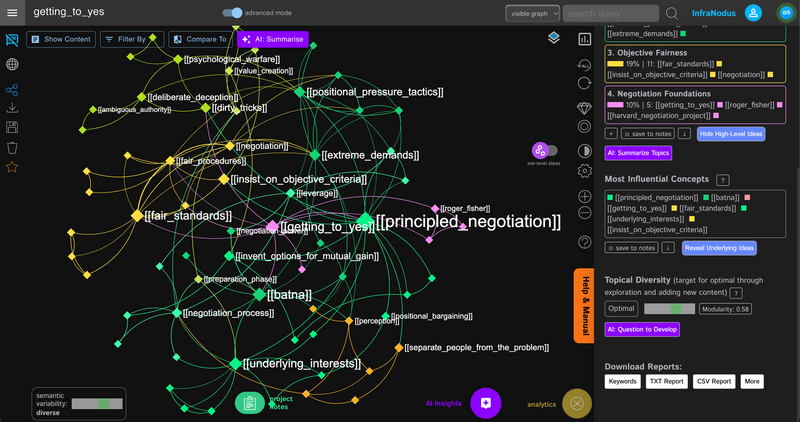
infranodus.com ↗InfraNodus turns a body of text into a network of concepts and shows where the discourse has gaps. The part that interested me sits above that: it names four states a piece of thinking can be in, biased, focused, diversified and dispersed, reads the shape of the network to say which one the user is in, and suggests the move to the next. It gives the user a view of a process that normally stays invisible, and it was the clearest answer I found to a model that narrows the options and calls it a choice.
-
Fisheye
wattenberger.com ↗Fisheye borrows a lens from geographical maps and applies it to reading, so a person can dive into a paragraph while the surrounding context stays visible. It matters because a language model can write the same passage at several depths on demand. Level of detail stops being something the author fixed once and becomes something the reader sets, moment by moment. A chat answer arrives at one depth and asks you to take it; this asks how deep you want to go.
-
Memolet
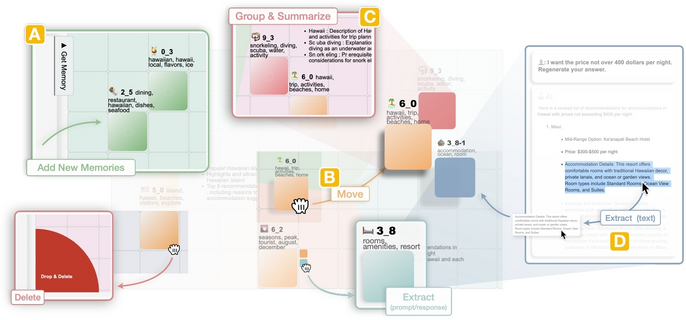
Watch the demo ↗Memolet turns pieces of a conversation with an assistant into objects on a canvas, which people move and reuse to build the context of the next prompt. Giving memory a physical form is what makes it interesting. Once context is something you can pick up, group and set aside, the user has a way of saying what matters that a typed instruction does not offer: intent gets expressed by arranging things rather than by describing them. A research prototype from the University of Waterloo.
-
Jelly
CHI 2025, paper ↗Jelly builds an interface from a written request, panel by panel. What sets it apart is what it generates: not code, but a model of the task itself, the entities and the relations the work involves, which is then mapped onto the interface. Because that model stays in place, people keep reshaping the result by asking for changes or by moving things directly. The interface stops being a one‑shot answer and becomes something the two sides adjust together. Research from UC San Diego, CHI 2025.
-
Glean
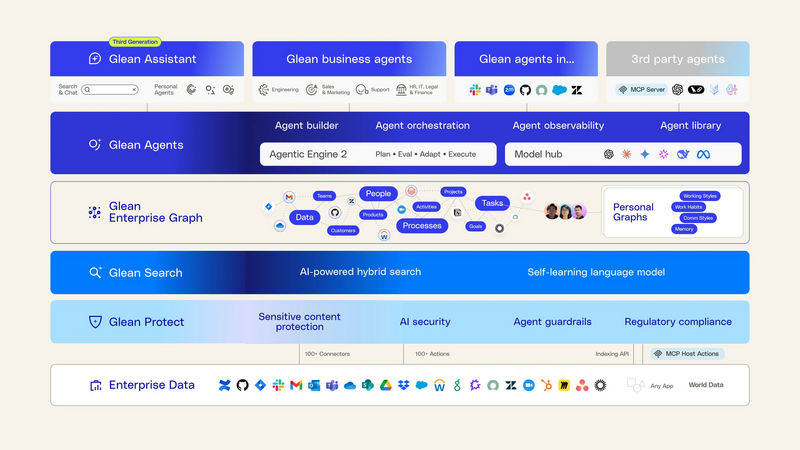
glean.com ↗Glean organises corporate knowledge in a graph‑based retrieval system that reaches into the tools a company already uses, so the assistant answers from what the organisation actually holds. What I kept was not the technology but the habit around it. A knowledge base decays the moment nobody tends it, and the lesson I drew from Glean was to tie that upkeep to a ritual the company already runs instead of asking for a new one.


What the collection produced was a shared catalogue of stimuli.
Once a team can name non‑linear exploration or adaptive interfaces, an interface choice stops being a matter of preference and becomes a matter of which cognitive problem it solves.
Impact
-
The research fed the design pillars and the AI response logics
The work on human‑centred artificial intelligence went into the pillars that governed interface decisions, and the knowledge visualisation patterns went into the logics that shaped how the assistant responds and how it shows what it knows.
Reflection
Research is only as valuable as its actionability
For months I kept the metacognition work in the background. It produced no interface and no artefact anyone could ship, only a map of where thinking breaks down when a person works with an AI model. Writing this case study changed how I read it: that map is what holds the collection together, because it gave me a way to say why a reference deserved the team's attention.