Orsero AI Envisioning Workshop
How might we help a client discover where AI can create real value inside its own processes?
My role
Service designer and workshop co‑lead. I owned the engagement end to end: workshop planning, materials design, facilitation, and rationalisation of the output back to the client.
Team
Design Group Italia [Alkemy], across three practices:
- Service Design: Nicola Notarnicola and Sonia Balduzzi
- Data & AI
- Business development
Facing 19 participants from Orsero, from analysts and process coordinators up to C‑levels
Timeline
April 2026 - Two weeks end to end

Activities
- Workshop design and facilitation
- As‑is process mapping and pain point identification
- Problem and opportunity framing
- Prioritisation and roadmapping
Deliverables
- Workshop toolkit: agenda, canvases and templates
- Four solution concepts
- One enabling data initiative
- Post‑workshop report with prioritisation matrix and roadmap
Outcomes
Five hours of structured co‑creation turned scattered daily frictions into four project concepts, plus the enabling initiative sitting underneath all of them, shaped by the people who run those processes every day.
Problem and context
Orsero distributes fresh fruit and vegetables at scale. It is a business where margin depends on timing, on quality, and on how well commercial, administrative and operations teams stay in step with each other.
The request was about how to leverage AI. Leadership wanted to know where AI could realistically improve internal processes in the short to medium term, and they wanted the answer as a shortlist of things worth funding. Expectations in the room were shaped by the way AI is usually sold: name the outcome you want, and assume the technology will close the distance from where you are today.
That is where the brief needed reframing. AI does not sit on top of a process, it sits inside it, and it needs two things the organisation has to provide: data it can understand, and a process clear enough to enter. So the main question was never which AI tool to buy or build. It was which of these processes are legible enough to receive one, and what has to be true before any of them can work.
User goals
- Share the frictions that shape daily work, in their own words.
- Meet the other functions and see the constraints they work under, especially during process hand‑offs.
Business goals
- Identify pilots that are actionable within months, not years.
- Know which investment to make first, and why.
Approach
I had about a week to prepare, so I started by taking the room off the blank page. A survey went out to participants to collect the frictions they meet daily, which let me open the workshop on their words rather than on our slides. It also let me compose the tables by affinity of problem rather than by org chart. Reading the answers, I saw that a large share of contributions belonged to areas covered by other teams, so I redistributed them and opened each table by showing where its themes had landed. Telling people their input was already at work somewhere else in the room bought attention I would otherwise have had to earn during the day.
The day ran on four tables, one per business area, each with a service designer facilitating and a domain expert from the Data & AI team as technical support. Every table followed the same sequence: silent individual reflection, sharing at the table, then a vote to converge on one problem area. From there we mapped the process as it works today, marked the pain points on the map, and only at that point opened ideation. A plenary closed the round.
Starting an activity with individual reflection is a habit of mine, and in this room it mattered more than usual. The tables mixed analysts and process coordinators with the chief operating officer, the group CFO and the CEO. When seniority in a room is that uneven, silent writing followed by structured sharing is what gives quieter voices a way in. Writing alone before speaking protects the range of perspectives you invited people for.
Two choices did most of the work. The first was mapping the as‑is process before opening ideation: you cannot decide where AI belongs until the process it has to enter is visible on the table. The second was letting the AI expert speak last in each round, so that technical feasibility rationalised the ideas after they had formed instead of anchoring them from the start. Everything was done on paper, which kept senior stakeholders in the conversation rather than behind a laptop.
This was also the first time three teams inside Alkemy, my company, worked together on the same engagement: Business development, Data & AI, and Service Design. Sitting between them was part of my responsibility. The machine learning and data engineering courses I studied on my own time paid off here, not because I write models, but because I can follow the reasoning of the people who do. That shared language let me translate technical constraints into business terms for the client, and it earned me enough credibility with the AI team to push back on scope when a proposal drifted away from what the room had actually said.
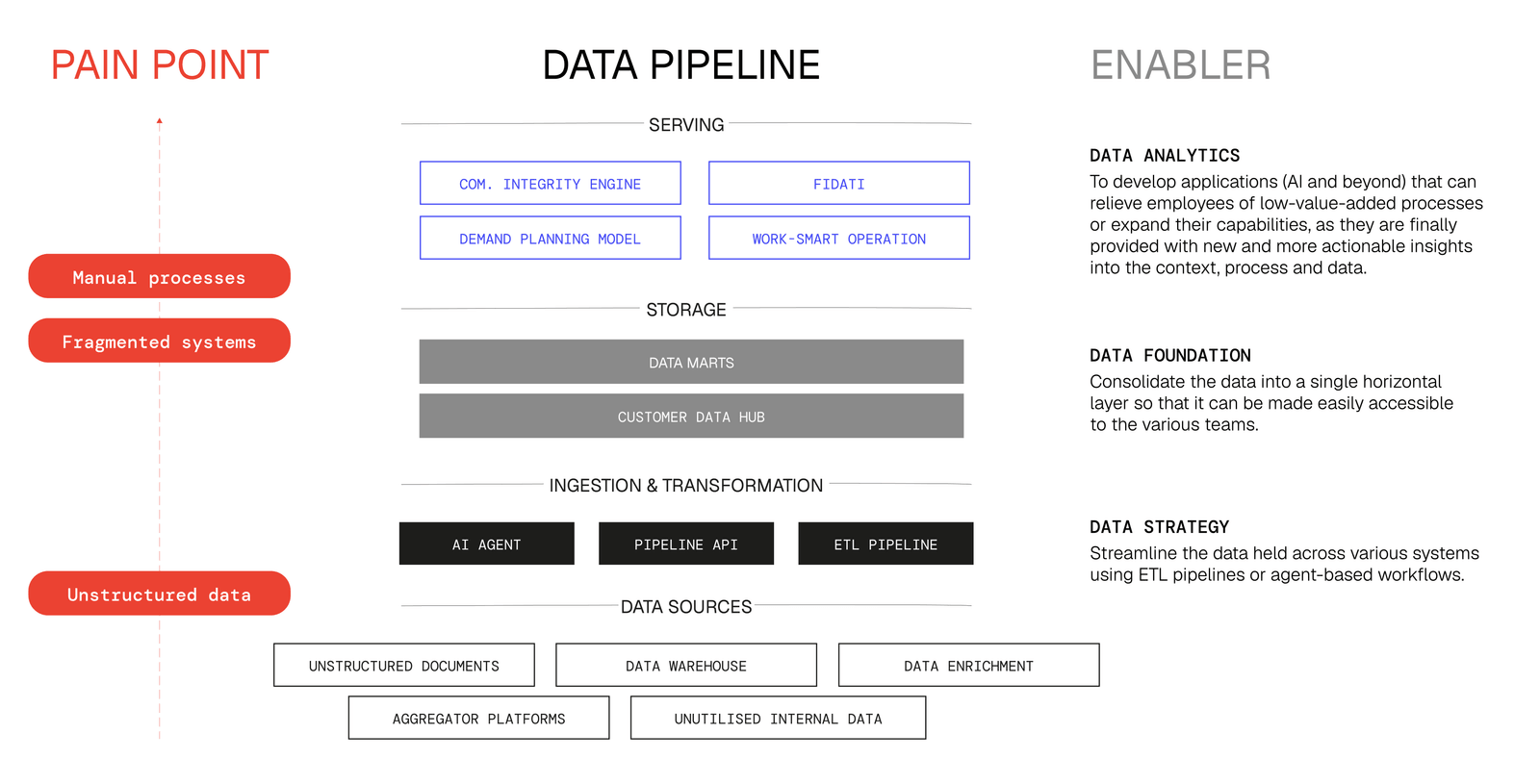
After the workshop I rationalised the output against the data value chain, the framework the company uses for AI programmes. It runs in five steps: data strategy, data foundation, data analytics, data science and AI, and data activation, with culture and training cutting across all of them. Data without a strategy is noise, and a model that never reaches activation stays academic, so value only appears when an organisation walks the whole path instead of jumping to the AI step. There is nothing original in the framework itself; it is established practice. The difficult part is helping a client see why foundation work is worth funding when it produces no visible feature.

Solution
Each table produced one concept. Administration worked on reconciliation and order control, HR on payroll data validation, sales on demand forecasting, and operations on dynamic staff planning in the warehouses. Four different functions, three shared frictions underneath: fragmented systems, unstructured data, manual work.
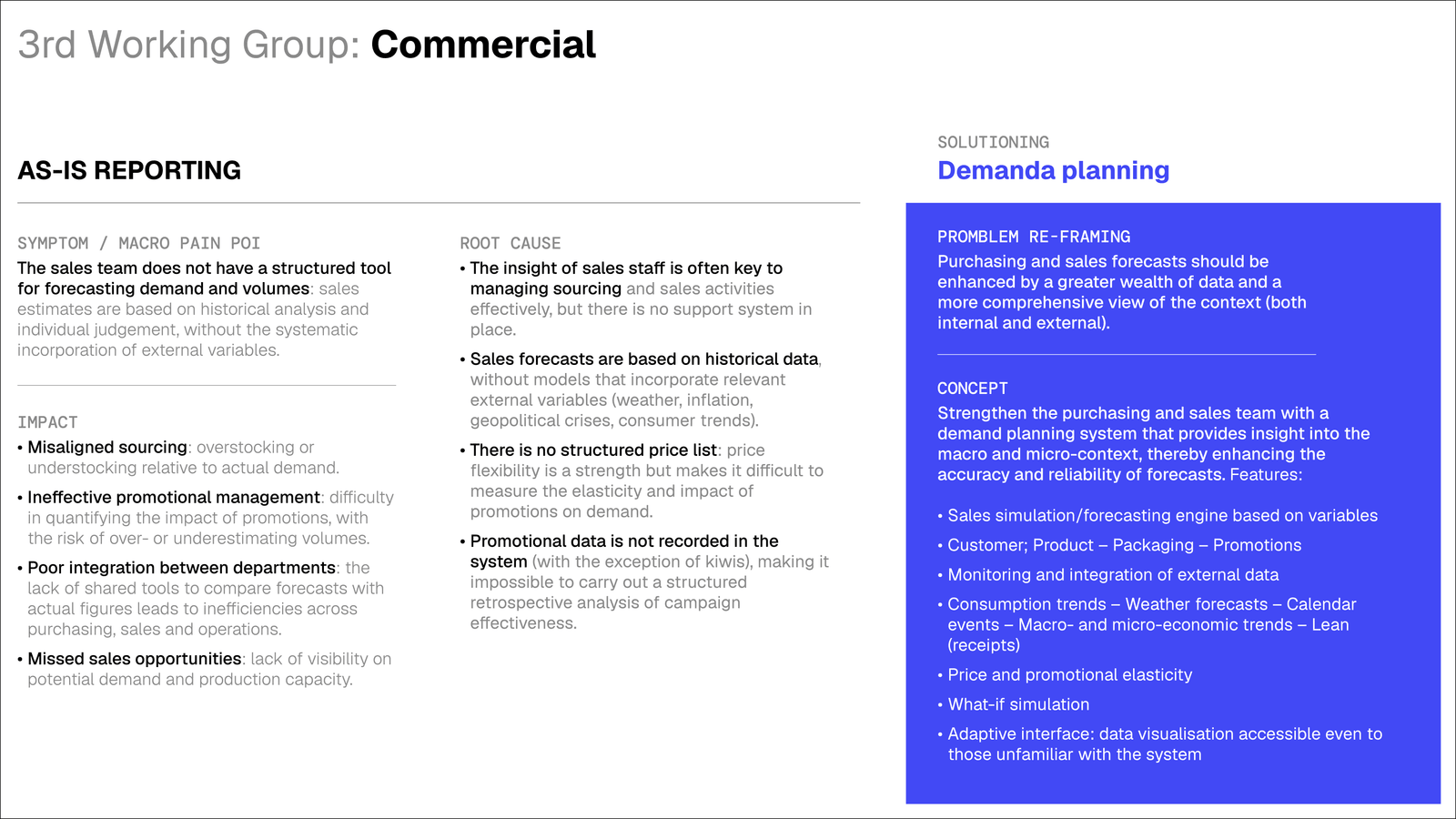
In the report I documented every concept with the same four‑part structure, so that four ideas coming from four different rooms could be read and compared side by side:
- As‑is reporting: the macro pain point, its root causes, and its impact on daily work and on the business.
- Solutioning: the problem reframed, and the concept proposed against it.
- Data pipeline to‑be: the data the concept needs, from source to serving.
- Pilot proposal: scope, stakeholders to involve, expected deliverables.
That structure is what gave the client something to decide with. For every initiative it showed what building it would take, who had to be involved, and where it stood against the others on business impact and implementation complexity.
Then I placed the four concepts on the data value chain. All four sat on the same starting point: data that is clean, structured and shared across systems. That layer did not exist yet inside Orsero, and none of the four ideas could work without it. So the report added a fifth item next to the four concepts: a data foundation initiative.
That is the moment the picture changed for the client. They had come in with four things they wanted to build, and they left knowing that none of them would stand without the enabling layer underneath. The reframing did more than add a fifth line to the list. It moved the discussion from which use case to pick to where the group should point its resources first.
The day was framed as a search for AI use cases.
What it actually delivered was a shared picture of which processes were ready to receive one.

Impact
-
Four project concepts and one enabling initiative, produced in a single five‑hour session
Every concept came with scope, assumptions and the stakeholders needed to run it, so the client could decide rather than admire.
-
Orsero moved ahead with the data foundation work
The build went to an external provider, so the commercial return landed elsewhere. The diagnosis held anyway, and that is what a workshop can be judged on: the day changed what the group decided to do next.
-
A workshop format to reuse for future sessions
Business development, Data & AI and Service Design had never run an engagement together before this one. What survived the project is a structure the three teams can pick up again.
Reflection
Breaking silos and moving from symptoms to systems
Companies are still made of silos, and a workshop like this is worth running for that reason alone. At my table, operations planned production and staffing week by week, and their planning depended on inputs arriving from sales. The participants were experts in their own domain and named the same frustration: the numbers reach us late. They were right about the symptom.
Then the plenary reframed it. Sales were not sitting on their estimates. They were stuck behind constraints of their own, working without a structured price list and without promotional history in the system, which made a confident forecast almost impossible to produce. Nobody in that room could have seen the whole chain alone, because each function only ever meets the end of somebody else's problem.
That is the part I took away. The output of the day was a list of AI opportunities, but the more durable result was a single session in which four functions watched each other's constraints instead of guessing at them. I would now argue for spending more of the agenda on the moment where the tables compare notes.